Challenges of a First Product Management Hire
When every dollar counts, how can you, as a founder, mitigate the risks about making the wrong decisions for your first product hire.
TEAM BUILDINGFOR FOUNDERS
7/2/20262 min read
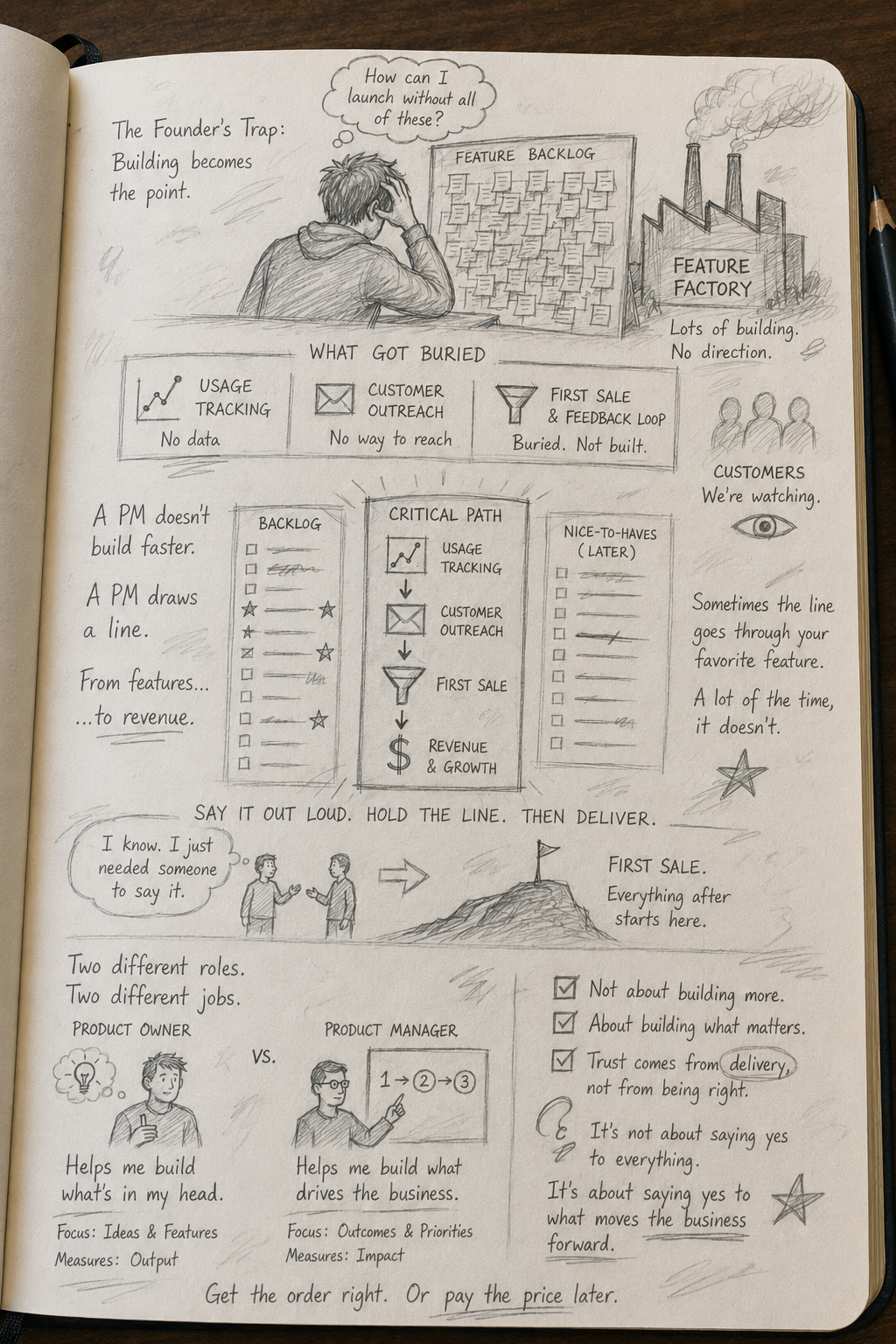
There are still founders who think they need a product manager actually need a product owner.
Those are different people. Different mindset, different skill set, different moment in the company's life. Confusing them is one of the more expensive hiring mistakes an early-stage founder can make.
I worked with a founder building a B2C e-commerce product. It was a great idea, but the backlog was so full of features that the noise drowned out the things that actually mattered.
We had no usage tracking. No systematic way to contact customers. The pipeline to our first sale and the feedback loop we needed to grow were both sitting on the list somewhere, buried under a hundred feature requests the founder was convinced were essential.
I worked these in where I was able, but it was a challenge getting him to recognize that these "less sexy" features were essential to profitability.
He wasn't wrong that those features had value. He was wrong about when.
This founder had found his way to building himself through necessity and had gotten stuck.
Somewhere along the way, the building had become the point, and the business, including its customers, the first sale, and growth had been pushed into the background.
He built a feature factory without meaning to.
A product manager's job in that moment isn't to build faster. It's about drawing a straight line between what's on the list and what actually drives revenue. Sometimes that line goes through the feature you were most excited about. A lot of the time, it doesn't.
When I showed him that usage tracking and customer outreach weren't nice-to-haves, that they were the critical path to the first sale and everything after it, he already knew. He just needed someone to say it out loud and hold the line while we acted on it.
That's what a PM does. But it only works if the trust is there first. And trust at that stage comes from delivery, not from being right.
In his mind he wanted a product owner, someone who would help him build what was in his head, but he needed a product manager: different skills, different price points, different goals.
There was a lot of friction and resistance, but eventually I was able to work with him to get the right things built and that first sale followed.
So before you write the job description, ask yourself one question.
Do I want someone to build what I'm thinking...
...or someone to tell me what order to build it in?
The answer changes who you're looking for. And getting it wrong costs more than the salary ever would.
If you're reading this because something in your own product or team is stuck, that's usually where I come in. I work with founders whose product exists, but the revenue doesn't. The first step is always a conversation, not a contract.
NEED HELP WITH YOUR PRODUCT OR TEAM?
A free 30-minute call to discuss your product challenge and see if it really requires a regular consulting engagement to work through.