Navigating the "Shadow PM" Pandemic
What do you do when your perfectly laid out roadmap is in danger of being sent off the rails in favor of the latest new and shiny feature set?
PRODUCT LEADERSHIPSTAKEHOLDER COLLABORATION
1/13/20264 min read
You’ll rarely hear a product leader admit to challenges that come from inside of their organizations. Everyone just works and plays together perfectly all the time. The resources are there when you need them. You may get challenged, but have the right information available at all times. Logic is your ally and together you’ve built great things.
That’s just nonsense.
Logic, reason, and even customer needs can find themselves pushed aside. It’s a phenomenon that keeps product leaders up at night: The Shadow PM.
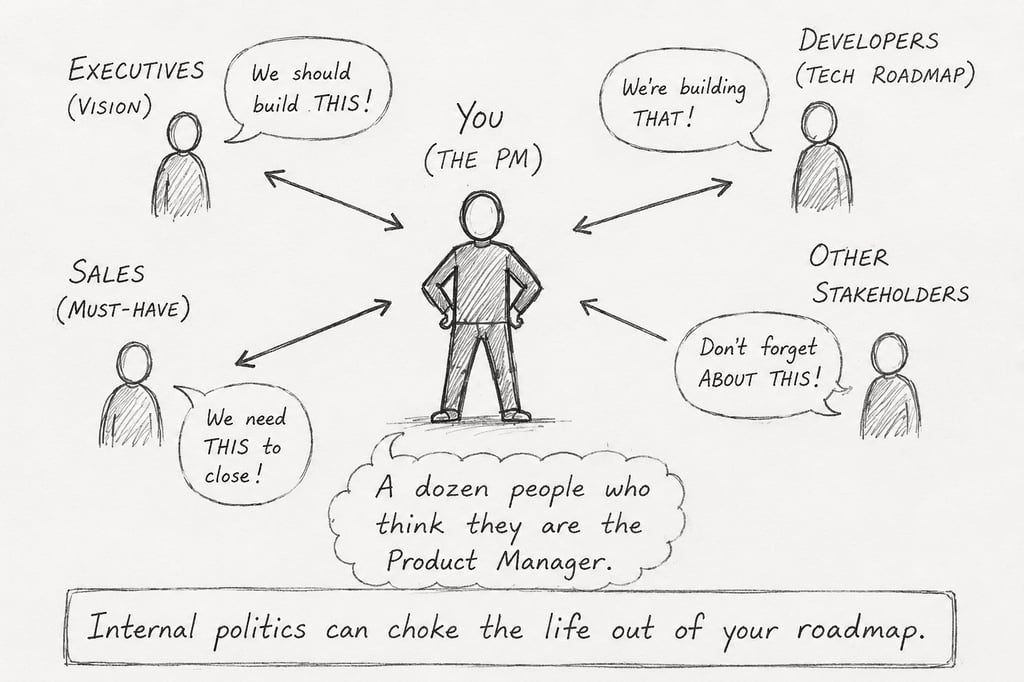
In a startup, everyone is a "builder." Executives have vision, Developers have their own technical roadmap, and Sales has a "must-have" feature to close the next big deal. Suddenly, you aren't just managing the product; you’re managing a dozen different people who think they are the Product Manager.
I can tell you firsthand that the view from the trenches is not pretty.
I’ve seen the life choked out of more than one roadmap due to internal politics.
If I were your product coach, I’d ask you to take stock of your talents before you take offense at interference from wanna be product leaders. When the cabin gets crowded with competing directions, you don't win by shouting louder. You win by looking out the windshield at the only thing that matters: the person paying for the gas: the Customer.
Trust the Uncomfortable Story
Early in my career, I was brought in to guide a new application server through its launch plan. On paper, it looked wrong. It didn’t fit the model of any of its competitors in its space. Instead of being built to leverage high-end hardware, it was a loosely cobbled together toolbox of capabilities. Internally, that was an uncomfortable story to tell. There was pressure to make it look and act like the "standard" winners in the market.
But when we took it to the field, that "uncomfortable" story was exactly what resonated with our customers. Components were allowed to shine in a distributed management platform that evolved as more Fortune 500 brands lined up. They didn't want a monolithic platform; they wanted the flexibility to enhance online shopping experiences with distributed management, security, and personalization that actually fit their workflow.
The product was a winner because we stopped trying to make it fit an internal narrative and started positioning it for the reality of the customer’s transaction-heavy world. It launched as a giant because the customers found their way to the truth before we did.
The Customer’s Voice is the North Star.
Full stop.
Let’s say it another way: The customer’s voice counts more.
One of the most dangerous things a startup can do is treat the Voice of the Customer (VOC) as just another "opinion" to be weighed against management’s gut feeling.
As long as what they are asking for aligns with the vision statement, their voice carries more weight than any single internal stakeholder. When we "cut the legs out" from under the customer by treating them as just one of many stakeholders, we destroy the trust required to build a lasting brand.
Patterns in the Noise: The Power of the Chorus
It’s easy for a "Shadow PM" to dismiss a single customer as an edge case. Expertise lies in recognizing the chorus. The real magic happens when you hear five different customers saying the same thing in five different ways.
To the untrained ear, disparate requests for "tools" rather than "features" might seem messy. To a seasoned eye, this is a pattern. When some people hear collection, I’d encourage you hear, "tools to aid the customer in getting their job done."
When you find these patterns, bring them together:
Synthesize the "Why": Group these disparate voices into a single problem statement. Show management that this isn't about one "whiny" user; it’s about a market segment hitting a wall.
The "Customer Council" Effect: If you’re unsure, bring these customers together. Ask, "I’m hearing 'X' from others, does that resonate with your friction?"
Watch Them Work: You cannot understand a customer until you see their "hacks." If multiple customers are using the same set of tools to solve a core problem, you’ve found your winner.
Communicating Expertise in the Chaos
If people don't understand what you do, it's likely because you’re speaking "Product" while they’re speaking whatever language is easiest for them to understand. I recommend working with your "Shadow PMs" separately. Sit with them one-on-one. Show them the architected path you’ve built alongside the people actually paying the bills. When you show management that the world’s biggest brands are choosing to listen to their customers as opposed to delivering something cool, the internal "gut feeling" seems a lot less relevant.
Stay Sane, Stay Curious
I’ve failed at this before. I’ve been the person who got frustrated because a founder didn't follow the "standard" product process. But being an expert is an opportunity to try new things, not be a gatekeeper.
Embrace the unpolished energy of the startup. Use your knowledge to provide the winch and the recovery gear when things get stuck, but stay open to new ways of navigating. Your sanity returns the moment you stop trying to control the people in the car and start focusing on the destination the customer is trying to reach.
Eyes on the trail
The road is bumpy, and the cabin is loud. But if you keep the customer’s voice, and the patterns within that voice—as your primary driver, you’ll find that the "Shadow PMs" eventually stop grabbing for the wheel and start looking to you for the route.
How do you handle it when your customer data tells a story that management finds "uncomfortable"?
Related Posts
If you're reading this because something in your own product or team is stuck, that's usually where I come in. I work with founders whose product exists, but the revenue doesn't. The first step is always a conversation, not a contract.
NEED HELP WITH YOUR PRODUCT OR TEAM?
A free 30-minute call to discuss your product challenge and see if it really requires a regular consulting engagement to work through.