
The PM's Guide to Building a Shared Language
Unlock the secrets of better stakeholder communication by not assuming what "common language" is and put in the work to build a shared vocabulary.
PRODUCT LEADERSHIPSTAKEHOLDER COLLABORATION
1/7/20264 min read
There's an all-hands meeting where everyone nods in agreement, yet somehow, weeks later, the delivered product feels… off. It’s not a technical failure; it’s a linguistic one.
You've been there or have heard about this sort of thing.
In my two decades as a product manager, I've seen more promising initiatives derailed not because of bad code or a flawed strategy, but because different teams were operating under different definitions of the same core terms. "Value," "Performance," "User Experience", these aren't universal truths. They're just concepts, shaped by the context of who's speaking. And if you, as the product manager, aren't actively translating and aligning these definitions, you're building silos, not products.
The Babel of the Backlog: My "Value" Crisis
Early in my career, I was driving the development of a new feature for an AI-enabled e-commerce engine. The goal was clear: deliver "more value" to our B2C e-commerce clients. Simple, right?
Not so much.
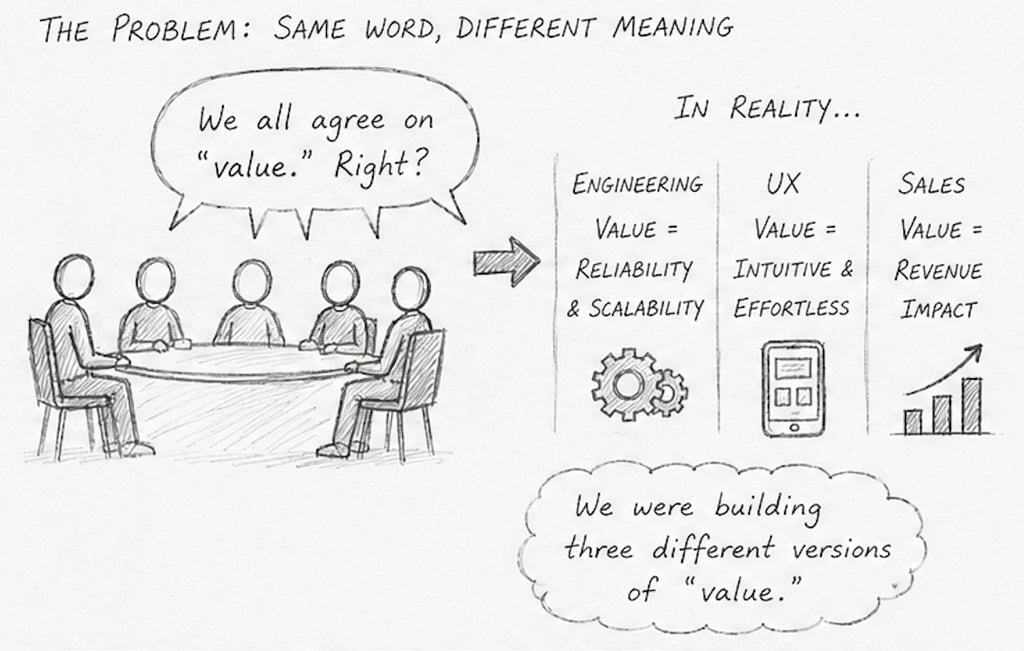
In our internal meetings, "value" took a different form in each stakeholder's mind. To our engineers, it often meant system reliability and scalability, ensuring the system could deliver thousands of requests simultaneously with sub-100ms response times every single time, without a miss. For the UX team, "value" meant intuitive design and minimal clicks, making the personalized shopping experience feel seamless and effortless. And for the Sales team, "value" was purely revenue impact, the ability to articulate a clear ROI that closed deals and retained customers.
We were all smart, dedicated people, and got along great in and out of the office. We were all working towards "value." But we were literally building three different versions of it. The engineers prioritized robustness, UX focused on elegance, and Sales wanted a talking point for their next pitch. The result? A product that was technically sound, looked good, but struggled to hit the sales targets because its core "value proposition" was fragmented internally.
It was a crucial lesson: Assumed understanding is the silent killer of product execution.
Building Your Product Glossary: From Chaos to Cohesion
Your job as a PM isn't just to gather requirements; it's to be the chief translator and architect of a shared language. This isn't about enforcing your definition; it's about facilitating a collective understanding.
Here’s how to start:
1. Listen to the Dialect of Frustration
Customers rarely use technical jargon. When they say your tool is "clunky" or "slow," they're not always talking about server latency. They might mean:
"It takes too many steps to get to the report I need."
"I have to export this data into Excel to combine it with other sources."
"The interface doesn't make sense for how I actually work."
Don't just log their complaint. Get into the why. Ask them to show you their screen and walk you through their process. Record their exact words. These unfiltered insights are gold. They reveal the true outcome they're struggling to achieve, and this becomes the common ground for all internal teams.
2. Bridge the Engineering-UX-Sales Gap with Outcomes, Not Features
Instead of asking your engineers for "a new dashboard" or your UX team for "better navigation," describe the desired outcome in the customer's language.
Instead of: "We need a new dashboard for sales data."
Try: "Our sales reps need to quickly see which product lines are underperforming this quarter so they can adjust their pitch strategy today."
When the delivery team, from product designers to front-end developers, understands the emotional context and the ultimate goal, they don't just build features; they innovate solutions. They might propose a notification system, a predictive alert, or a simpler reporting structure that you, as the PM, never even considered. They become problem-solvers, not just order takers.
3. Qualify Internal Noise with Unbiased External Data
Every internal stakeholder has an opinion, and often, those opinions are valid from their perspective. Sales wants a feature to close a deal, Support wants a bug fixed that's causing high call volumes, and Marketing wants a new ROI calculator to sell their latest campaign.
Here’s where you leverage external insights, not to dismiss internal feedback, but to qualify and prioritize it.
For example, a sales leader might insist on a new integration for a niche customer segment. Instead of immediately adding it to the backlog, qualify it:
What are 3rd-party consultants saying about this segment's broader tech stack?
Does market research indicate this segment is growing or shrinking?
Are there other customers (or potential customers) indicating a similar need?
By using external market trends, competitor analysis, or insights from 3rd-party implementers (who I can tell you often see how your product interacts with a wider ecosystem), you create an "external shield." This allows you to say "no" to valid-but-not-strategic requests with data, not just your opinion. It helps maintain team cohesion by showing that decisions are based on a holistic view of the market and customer value, not just the loudest internal voices.
The ROI of Clarity
Building a shared language takes patience and effort. And it means facilitating tough conversations, documenting definitions, and constantly reinforcing the "why" behind every "what." But the return on investment is undeniable:
Faster Execution: Over the long haul, teams spend less time clarifying and more time building the right thing.
Higher Quality: Products are more cohesive because everyone understands the unified goal.
Stronger Relationships: Trust grows when stakeholders feel heard and see their perspectives integrated into a larger, coherent vision.
True Innovation: When your delivery team genuinely understands the customer's world, they become a powerhouse for groundbreaking solutions.
Product management isn't just about managing features or timelines. It’s about managing meaning. It’s about ensuring that, from the CEO to the front-line developer, everyone speaks the same language and works towards the same, clearly defined outcome. That’s where real product magic happens.
What’s the most misunderstood word in your organization right now and how are you bridging that gap?
Related Posts
I work 1:1 with product managers on one significant challenge at a time. Three sessions, one a week, and we review where you are and where you want to be rather than leaving you with a generic list of things to try.
My first question would be: What's the one thing you'd want to be different by the end of the month?
IF I WERE YOUR PRODUCT COACH...
It starts with a free 30-minute call to figure whether my style of coaching makes sense for you.